A Method for Learning Highpower Position Shooting I have discovered a few very simple methods to analyze position shooting. This may seem very basic to an experienced shooter, and frankly, I may be way off base here. Anyway, here goes... Highpower shooting is comprised of these basic parts:

|
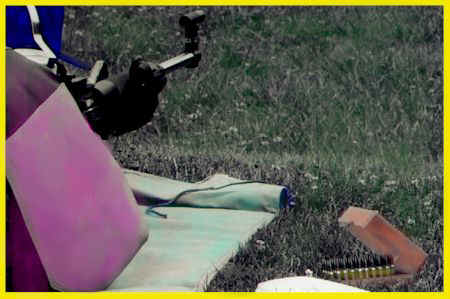
Bench
shooting
is
more
#1
and
#5. Using a scope allows you to exactly discern the target. |
 |
|
The
optical
advantage
is
significant. Very light triggers and sandbags make some of the other factors less important. So, to isolate your ability to see a x-ring bull with the naked eye, we will use the bench. Set up your highpower rifle up like it is a benchrest gun. Use front and rear bags. Plant the stock firmly in you shoulder and try to create a consistent stock weld. This ensures that your eye is positioned behind the rear sight the same way every time. Be absolutely sure of a x-ring sight picture and shoot some 10 shot groups. Be sure of a perfect sight picture. Use the bags to do the positioning. Shoot these groups from 200 yards and try to have low wind conditions. These groups will reflect your visual perception of a perfect sight picture. This is the goal for all the other steps. |
|
- For example, I can shoot ½ x-ring from the bench (3/4 minute), at this point in my career and with my first rifle, this isn’t bad. Certainly my "visual perception" of a perfect sight picture is good. I think I would be very happy to shoot ½ x-ring in my next match. That would be an 800-80x. Not bad!
- My zero does not change from the bench. I can repeat the ten shot groups and the quadrant of the x-ring remains consistent. Zero shifts are not resulting from my visual perception of the target.
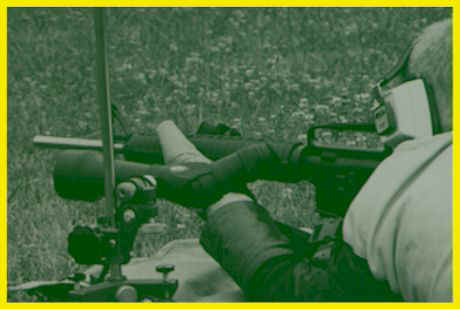
- Bench results should be somewhere near 1 MOA. If not, I would suggest some more bench time and see if there is the ability to improve. (I know highpower practice from a bench, what a coup!) Here is also the chance to see what your eyes are capable of, and what your rifle is capable of. You might find that glasses might help. There would be no point to move to position practice if you cannot perceive a bullseye with the rifle held in place for you.
- This also gives the opportunity to get some trigger time, and practice your trigger "break".
 |
Your ability to "hold" the x-ring should become immediately apparent. If not, switch back and forth from the bench to prone and shoot some groups. Pay attention to the level of your ability to hold. Do you see a 1 ring wiggle, a two ring wiggle, what? What the prone group looks like is really not that important at this point. All things being equal, can you hold the x-ring? | ||||||||||
|
|||||||||||

- The ability to consistently repeat a good "hold". From step (2) we know what a good hold is, now don’t we? Exact repetition means exact repetition!
- The rifle rides the body the same as a benchgun rides the sandbags. What is the rifle doing through the shot? Is you "hold" falling apart when it counts?
This is my biggy… At this point, I will say that I am losing at least 2 rings (counting flyers), in prone, due to poor position. At 600 yards, this could equate to 4 rings. Just due to me! I have yet to even talk about "condition"!
I am a notorious flincher. I guess it’s just the way my body works. I have to work exceptionally hard not anticipate the "break" of the trigger. Even with a .223 "mousegun", I have problems. My groups have tendency to fall out of the bottom.
(Please, any really advanced shooters who can tell me what to do about this e-mail me!)
In a nutshell my "hold" is not "holding".The gun is pointed in the right direction, but loses this "hold" at the wrong time. The prime candidates for failure are:
- Flinching-

- Mounting the rifle-
- Work specifically on mounting and remounting the rifle the same way. I hear a lot about dry firing; well, this is not dry firing. Set up your prone position and get a dot for the wall same as dry firing. The purpose of this drill not to focus on the shot, but the time immediately before the target focus. See if you can mount the rifle the same 10 times in a row without making any adjustments. Move the butt into your shoulder and look at the dot on the wall. Center the dot and get comfortable. Dismount the rifle. Remount the rifle, make no adjustments! Is the dot centered in the sights? If not, your position has changed. Don’t worry if you can’t do this, this is freakin’ hard! I would be happy to do this twice in a row, much less 10 times!
- (a) Should work equally well for sitting and offhand.
- I guess this is similar to "natural point of aim" with no emphasis on "aim". This is more like "natural position".
-
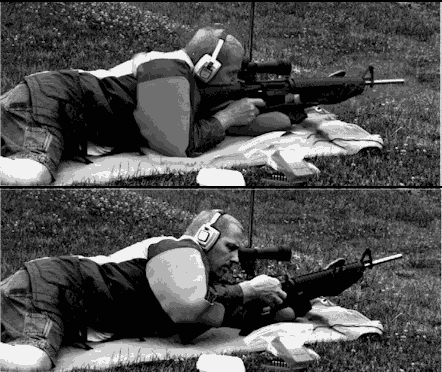
I see a tendency for my position to creep back into the right spot. This is a good thing, and can be used to your advantage. During the rifle mounting drill, if you have an occasion where the rifle is not centered on the bull, do not readjust immediately. Instead, relax and let the rifle settle into your body. If you did your work on your first setup, and you are truly centered on your "natural position", the rifle will begin to creep back into position. You may find that a readjustment is not necessary. Note: There will be no possibility of achieving "natural position" repeatedly, if the body is moving around between shots. Be paralyzed from the shoulders down.
|
|
| The GHogkiller Practicing "Natural Position" |
Note:
(d)
Should
work
equally
well
for
offhand
and
sitting.
|
Note:
When
I
teach
"the
golf
swing",
I
try
to
get
the
student
focused
on
what |
Follow through- most of the follow through, when you are slung up, is due to position. Some is visual focus, but I would say the bulk is "reaction of forces in recoil" (that there is engineerin’ talk for "where’s the boom goin’"). Pay attention to where the rifle goes to in post recoil. I guess it is safe to say that one would like to see the rifle right back on the bull after shot. I will also go out on a limb and say that it is not as important as the rifle following the same path every single time. The bull is just a good common visual reference. I actually seem to shoot my best strings when the rifle ends up just low and left of the bull every single time. The key phrase here is "every single time". If you can repeat a natural groove, I say "go with it".
- Again, I say go with more smallbore or air rifle practice. The effects of poor trigger pull are immediately evident with no recoil, especially with a good high power scope from the bench. Hate to bring this up, but a lot of accuracy is required, so I am not sure that the old Marlin in the basement will cut it. Note: A good, inexpensive alternative may be to hop up your Ruger 10-22 with a good barrel.
- Shoot a heavier trigger. I think there is a lot of benefit to be had from adding a couple pounds of pull to your practice smallbore gun. If you can break five pounds, you can damn sure break three.
- Better
triggers,
not
lighter
ones!
I
will
take
a
4-½
pound
trigger
that
breaks
like
glass
over
one
with
half
the
weight
that
creeps
and
breaks
at
different
weights
every
time.
I
want
my
brain
to
know
exactly
when
that
trigger
is
going
to
break.
I
have
seen
a
lot
of
emphasis,
especially
in
highpower
and
varmint
shooting,
on
lighter
trigger
pulls.
I
am
not
so
sure
that
a
lighter
trigger
helps
that
much.
A
better
breaking
trigger
helps
a
bunch!
Of
course
there
are
advantages
to
lighter
pull,
but
only
if
you
can
"feel
the
break".
| (Note: The only trigger I have seen for AR-15’s that breaks like glass is the JP Enterprises single stage.) |
|
|
The
Compass
Lake
is
the
most
predictable
two
stage,
but
let
Compass
Lake
adjust
it,
and
don’t
mess
with
it! (This is actually a whole ‘nother article). |
|

Condition- I suck at reading conditions, so I guess I will just skip this one. There is plenty of good stuff written about this subject, so you don’t need any help from me. I think the best thing to do is to get to know your rifle and ammunition. Pay attention to your zeroes and what affects them.
- Heat from the ground makes the bullet go up.
- Wind close to the shooter affects more than wind at the target.
- Better loads with better bullets cut the wind better.
- A good coach on the scope is worth more than anything.